PublishedAugust 26, 2026
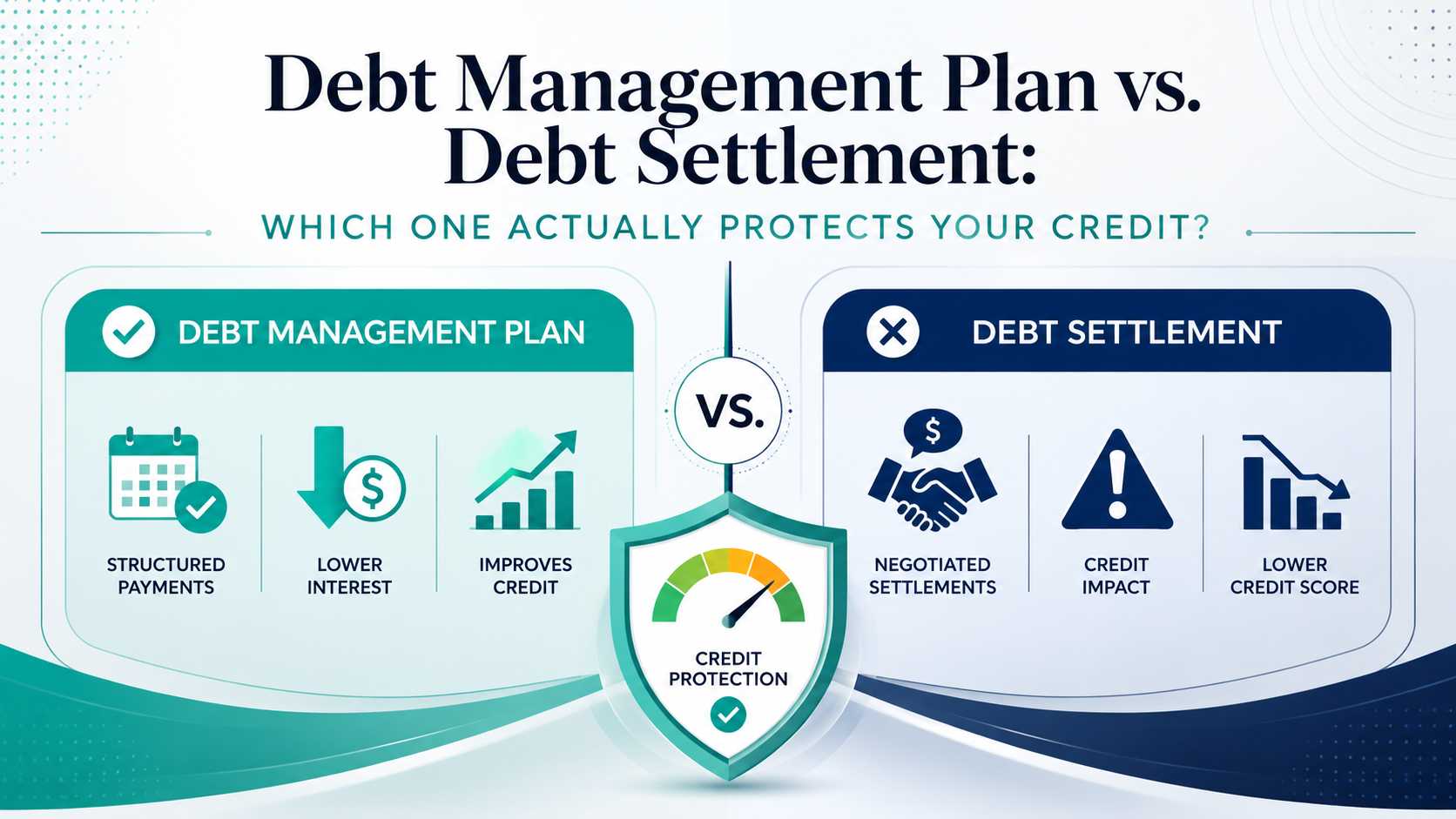
Debt Management Plan vs. Debt Settlement: Which One Actually Protects Your Credit?

Let’s talk about a number that is hard to wrap your head around. American households are now carrying $1.25 trillion in credit card debt. That is trillion, with a T.
The Federal Reserve Bank of New York released those numbers earlier this year. And while balances did dip slightly in the first quarter (people tend to pay down holiday spending in January and February), the bigger picture is not encouraging. Balances are still $70 billion higher than they were a year ago. Credit card interest rates are hovering near record highs. And millions of families are feeling it every single month.
Here is the part that really stings. According to data from nonprofit credit counseling agencies, household income has grown by about 22% over the past decade. That sounds decent until you learn that credit card debt grew by 54% over the same period. Debt is outpacing income by more than two to one.
Why? Because wages have not kept up with the cost of living. Groceries cost more. Gas costs more. Rent costs more. Childcare costs more. And when the paycheck runs out before the month does, the credit card fills the gap.
The average credit card APR right now is close to 20%. Many people are carrying cards at 25% or even 30%. At those rates, minimum payments barely scratch the surface of the actual balance. You pay and pay and pay, and the number on the statement hardly moves.
National statistics can feel abstract. So let’s bring it home.
Say your household has $10,000 in credit card debt at 25% APR. If you only make minimum payments, it will take you over 30 years to pay it off. And you will hand over roughly $18,000 in interest on top of the original balance. That is almost double what you borrowed.
This is not a made-up scenario. It is literally printed on your credit card statement. Federal law requires card companies to include that warning. Most people glance at it and look away because the numbers are uncomfortable. But looking away does not change the math.
The same Federal Reserve report shows that credit card delinquency rates are sitting around 8.6%. Before the pandemic, that number was closer to 5%. Millions of Americans are 90 or more days behind on their credit card payments right now.
When you fall behind, the consequences stack up quickly. Penalty APRs kick in, sometimes pushing your rate above 29%. Your credit score drops. Collection calls start. And in some cases, creditors pursue legal action or wage garnishment.
The stress that comes with all of this is real, and it spills into everything. Sleep, relationships, work, health. Financial pressure does not stay in its lane.
The single most important thing to understand is that minimum payments are not a strategy. They are designed to keep you in debt for as long as possible while maximizing the interest you pay.
Here is what a real strategy looks like.
Get everything on paper. List every credit card balance, its APR, its minimum payment, and its due date. Many people are surprised by the total when they finally see it in one place. This takes about 20 minutes and it changes everything.
Look into a Debt Management Program. A nonprofit DMP consolidates all of your credit card payments into one monthly payment and negotiates your interest rates down, often to single digits and sometimes as low as 0%. You are not borrowing more money. You are paying back what you owe, just faster and for far less interest. Most people finish in three to five years.
Talk to someone. A free counseling session with a nonprofit credit counseling agency gives you a clear picture of your options. It is confidential, takes about 20 minutes, and has no impact on your credit score. You do not have to commit to anything.
Do not wait. Research shows that one in five Americans wait until they are at a breaking point before seeking help. By then, the options are narrower and the outcomes are harder. The earlier you act, the more money you keep.
A $1.25 trillion national credit card balance is not just a news headline. It is millions of families carrying debt that compounds faster than they can pay it down. If your household is one of them, the situation is solvable. But acting now, before balances grow any further, is the smartest financial move you can make this year.
Progress is not always a dramatic drop in your balance. It can mean that you stopped adding new debt, reduced the amount of interest you pay, created a small emergency cushion, or made every payment on time for several months.
Give yourself a measurable target and review it regularly. When the plan is working, keep it simple. When it is not working, change the structure rather than blaming yourself. Financial plans are tools; they should be adjusted when your circumstances change.
You do not need to solve the entire problem today. Start by gathering the numbers you already have. Pull your latest statements, write down the balances and interest rates, and calculate the total minimum payment. Then compare that number with your take-home income and essential monthly expenses.
Once you know the gap, choose one action. That could be calling a creditor, canceling an unused recurring expense, moving a planned purchase to a later date, or scheduling a conversation with a nonprofit counselor. One clear action is more useful than spending another month worrying about the balance without changing anything.
You cannot control national debt levels, inflation, or the direction of interest rates. You can control whether you understand your own numbers and whether you have a plan. Calling a creditor to ask about hardship options, reviewing your budget, or speaking with a nonprofit counselor can all be productive first steps.
If the debt is manageable, a simple payoff plan may be enough. If high interest is preventing progress, restructuring the repayment terms may make more sense. The earlier you identify which situation you are in, the more choices you generally have.
You do not need a complicated financial dashboard. Track three numbers: total credit card balance, total monthly interest, and the amount you actually paid toward principal. If your balance falls only slightly despite making payments every month, that is important information.
Also watch your utilization. A card that is close to its limit can affect your credit profile even when every payment is on time. Paying balances down can therefore help in two ways: you reduce the amount you owe and potentially improve your credit profile as utilization falls.
The most useful question is not whether you made a payment. It is whether the payment changed your financial position.
The national debt number is useful because it shows the scale of the problem, but it does not tell you what to do next. Your own monthly cash flow matters more. Start by listing every credit card balance, interest rate, minimum payment, and due date. Then compare the total required payment with the money you have left after housing, utilities, food, transportation, insurance, and other essentials.
If the minimum payments leave almost no room for emergencies, the problem is not simply that you need more discipline. A high-interest debt structure can make it difficult for even a careful household to make progress. The goal is to create enough breathing room that your payment starts reducing principal instead of mostly covering interest.
Ready to see how much you could save? APFSC is a DOJ-approved 501(c)(3) nonprofit with 38 years of experience helping families get out of credit card debt. Your free savings analysis takes about 60 seconds and will not affect your credit score. See How Much I Can Save or call 800-738-4585.
Blogs
Stay informed with expert tips, financial strategies, and the latest insights to help you take control of your financial future.
 : Credit Card Debt Hit $1.25 Trillion in 2026. What Does That Mean for Your Family?
: Debt Management Plan vs. Debt Settlement: Which One Actually Protects Your Credit?
: Credit Card Debt Hit $1.25 Trillion in 2026. What Does That Mean for Your Family?
: Debt Management Plan vs. Debt Settlement: Which One Actually Protects Your Credit?
 : How to Spot a Debt Relief Scam in 2026: 8 Red Flags the FTC Warns About
Contact us


